WHY ARE YOU
DOING THAT?
 (The devil made me do it.)(The devil made me do it.)
 Part of resolving a problem situation is making sense of it.
This page presents five views on how to figure out why a youngster is misbehaving. The first model represents the views of Rudolph Dreikurs. The second represents the views of behaviorists who advocate for the process and procedures of applied behavior analysis. The third involves discussion with the student. The fourth is a procedure known as "Functional Behavior Assessment". The fifth process is based upon the "Circle of Courage" model. But first, some some items to answer in order to start the process:
-The first (given) name of my most persistently non-compliant student:__________________
-This student’s defiance usually takes the form of: (Please be specific in your description. Elaborate upon general descriptors such as "rude", "defiant", and "pesky". Identify observable actions that are displayed, such as "Direct verbal refusal of teacher directions.","Tearing up of assignment after initial attempt to begin.","Asks ‘Why’ after directions to engage in an action.")
-I remember one time when:
(Provide an illustrative example of the persistent behavior)-My best guess as to the cause of his/her pattern of behavior:
-Things that seem to "set off" or instigate this behavior:
-What signals/signs cue me to an impending episode:
-Things I've done to prevent the occurance of the behavior include:
-When the behavior is displayed, my usual response is to:
-Things I’ve tried that didn’t work:
-Things I’ve tried that had some degree of positive influence on the behavior:
-Things that work well all or most of the time with other kids:
___________________________________________
ASSESSMENT MODELS
VIEW #1 DREIKURS
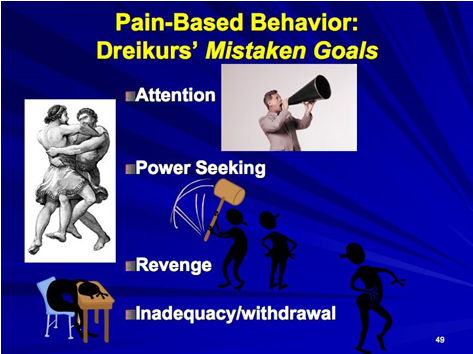
According to Rudolph Dreikurs, kids misbehave and seek "mistaken goals" when they do not have a sense of belonging or being valued by important people in important life settings. He provides a way to determine the function of/reason for a youngster's behavior. The system applies to behavior that results from a desire to socially and emotionally connect with others. It is not intended to explain all behavior. It provides guidance in understanding youngsters who have "internal" reasons for their behavior (a need to be psychologically attached to others), versus "external" causes. Kids misbehave for reasons unrelated to gaining personal contact with others. They might be bored with the lesson; the assignment may be too difficult (or simple); medication reactions may lower tolerance levels and behavioral restraint; poor parenting failed to teach "manners"; love of learning, and respect for others; desire for money/material goods; etc. We should also keep in mind that some youngsters have not learned how to behave in the manner expected in schools. Many low income, immigrant, and/or culturally different youngsters may have learned other "right ways" to behave in certain situations and group settings. They may need to be taught the behaviors that you expect them to display in your classroom (or you might have to change your ways to be more accepting of diversity and differences).
According to Dreikurs, kids act up due to a need for belonging...being a valued, contributing member in settings where they find themselves (home, school, after school activities). Here's a little background before solutions are presented.
 ATTENTION SEEKING
Pesky, attention seeking behavior results when kids aren't getting the recognition they feel they deserve. If they can't get attention for their positive behaviors (e.g., being on-task, completing work, arriving on time, being nice to others), they'll seek it with inappropriate behaviors. They feel important if the teacher pays attention to them and provides them with extra services. While they desire positive attention, if they aren't skilled at bring it to them (or the adult fails to give positive notice to appropriate behavior), they will engage in inappropriate actions. Negative attention trumps no attention at all. It at least provides the surface trappings of being "important" and "belonging": the person pays attention to you. They may:
-continually call out
-refuse to work unless a teacher hovers over them
-ask irrelevant questions
So be sure to "catch 'em being good".
SEEKING POWER
If attention seeking doesn't work, youngsters, out of spite, may try to make your professional life miserable. They may:
-argue
-contradict
-lie
-refuse to work or follow directions
-throw a temper tantrum
-tell you to "go take a flying leap"
-behave hostilely toward you
These actions usually bring your undivided attention, giving him or her power over your actions.
 SEEKING REVENGE
If attention or power seeking doesn't work, kids may seek revenge against you or others. Unable to gain power in a face-to-face struggle, they retaliate in secret. Their belief is that: "I can only feel significant if I hurt others. I'm just doing what they've done to me. I don't care if I'm disliked. They deserve this behavior. It is a noble act to stand up to them. It is a victory of sorts to be disliked and to undergo punishment." These kids may:
-treat others cruelly
-set themselves up to be punished
-engage in pranks or vandalism behind your back
DISPLAYING INADEQUACY  Was Killroy here?
Underneath the bravado of seeking revenge is deep discouragement. The continued rejection by others eventually makes them feel worthless. They think: "Why even try anymore?" They guard what is left of their self esteem by removing themselves from public and social tests. They think: "If I pretend to be stupid or refuse to cooperate, people will leave me alone." They may:
-passively refuse to participate in class activities
-sit silently and engage in no interaction
-request to be left alone
 SO WHAT DO WE DO
Assessing the "mistaken goal" and what to do about each of them is provided in this entertaining & informative video series. Click on image found below for more information.
IEP TEAMS: Go beyond A-B-C Analysis to "D" (Driekurs' Mistaken Goals Analysis)
.
VIEW #2 THE BEHAVIORISTS' A-B-C MODEL
Those who advocate for "applied behavior analysis" would offer the following advice when trying to determine why a youngster demonstrates certain behaviors: Identify the behavior of concern, defining and describing it. Next, try to determine what event(s) happened right before that behavior. Finally, note what happens as a result of the youngster's behavior. With this information, you should be able to make a good guess at what brings about and maintains the youngster's behavior. This information can also be used to modify or eliminate the behavior.
The behaviorist paradigm for determining the "why" of a behavior is identified by the symbols A, B, and C, representing "Antecedent" (the stimulus that caused or "sparked" the behavior), "Behavior" (the student's action that followed the antecedent), and "Consequence" (the reward that followed the behavior). Behaviorists believe that people show behaviors because they get some sort of reward for doing so (e.g., attention, power, recognition, money, release from assigned duties, physical pleasure, etc.). In their minds, behaviors (your's, mine, and the kids') continue and become ingrained because those actions bring something desirable to us, or remove something undesirable from our midst.
When dealing with student misbehavior, the trick is to figure out what is maintaining the behavior and then manipulate the environment so that behavior no longer receives that reward.
If the behavior receives no reward, it will cease (after an initial escalation of the behavior in continued and intensified attempt to obtain a reward in the way that has worked previously).
Another approach is to require a new behavior in order for the student to get the desired reward. We ask the student to demonstrate a replacement behavior if he or she wishes to obtain the desired reinforcement.
A third approach is to manipulate the situation so that the antecedent never occurs. The behavior won't happen if there is no stimulus for it to occur.
You see that you can change the A, B, or C (or combinations of them).
Example
The teacher asks a question to the class (Antecedent). Raheem yells out an answer (Behavior). Teacher tells Raheem to raise his hand next time (as s/he always tells him to do), but accepts the answer and goes on with the lesson (Consequence - Raheem got to show how smart he was, beat out his competition...other kids, and even got a bit of personal interaction from the teacher during the lesson).
In this situation, the teacher could eliminate the antecedent by calling on particular students (after the question is said, not before...or all the other students will let their minds wander). The teacher might also change the consequence by ignoring the answer ("I only hear the answer of students who raise their hands and wait to be called upon. I'm looking for a hand.") or penalizing "calling out" behavior (while praising the hand raising of other students). The teacher might also work with Raheem to develop a new behavior to get the reward/reinforcement. Each time Raheem raises his hand (whether he knows the answer or not, and whether he is called upon by the teacher or not) he gets a point. Twenty points allows him to present information to the class tomorrow, or gives him five minutes of personal time with the teacher (allowing him to receive the desired rewards of appearing knowledgeable or gaining personal contact with the teacher).
| Click here to view a PowerPoint slide show: How to determine the cause, purpose, or function of a behavior |
VIEW #3 Dr. Mac's Compassionate Questioning
Why don't we just ask the youngster? Easier said than done. Remember back to when you have been questioned about personal issues by those you didn't know, didn't like, or didn't trust. Were you be totally honest? Did you avoid saying some things? Did you mislead them?
Certain conditions must be present if you are to gain useful information from youngsters:
1. The student has to like you, value your input, and trust that you will use the information in a caring way.
2. You must ask in a way that evidences concern, caring, and respect. This interview is not an inquisition. Really listen...don't give into an urge to lecture or badger. Avoid making judgements. Simply gather information.
Certain practices will help the youngster to share his/her thoughts, view, and insights:
1. Active and non-directive listening (see the "non-directive counseling" link on the home page).
2. A systematic approach (see the "classroom counseling" link on the home page).
VIEW #4 Functional Behavior Assessment
A functional behavior assessment attempts to figure out the purpose of the behavior (Why would someone show a behavior if it didn't have a purpose such as bring a reward or avoiding something undesireable?) Once we know the reason, we can design interventions.
| CLICK HERE for the link that explains how to conduct a functional behavior assessment. |
View #5 The Circle of Courage
The "Circle of Courage", a psychoeducational model, attempts to explain why kids misbehave. It can be used as an assessment device AND guidance for intervention.
| CLICK HERE for the link that explains the Circle of Courage explanation for misbehavior. |
.

Pooch, I see you running alot. Can you tell me about it?
| Fetch Dr. Mac's Home Page |
Author: Tom McIntyre www.Behavioradvisor.com